OGMP 2.0 – What is it and how does it work?
One of the most contentious issues in climate reporting (especially with finance and emissions) is credibility of reporting standards. Due to the historic lack of globally accepted classification standards and the likelihood of states to re-class official development assistance as climate finance for example, the existence of a universal reporting standard for emissions tracking is a huge step in reaching net-zero.
Step in OGMP, the Oil and Gas Methane Partnership of the United Nations Environment Program (UNEP). Since 2014 and especially 2020 when it became 2.0, OGMP has been the Gold Standard comprehensive measurement-based reporting framework for methane emissions reporting. It covers all material sources of methane emissions, from both operated and non-operated assets across all segments of the value chain. As a multi-stakeholder partnership that brings together oil and gas companies as well as international organizations, governments and non-governmental organizations to improve the accuracy and transparency of reporting of methane emissions, it is key to methane mitigation in the oil and gas sector.
OGMP has five Levels of reporting, reconciling source and site emissions for companies that do the ambitious and granular work to achieve and maintain its Gold Standard. The Levels are explained further below:
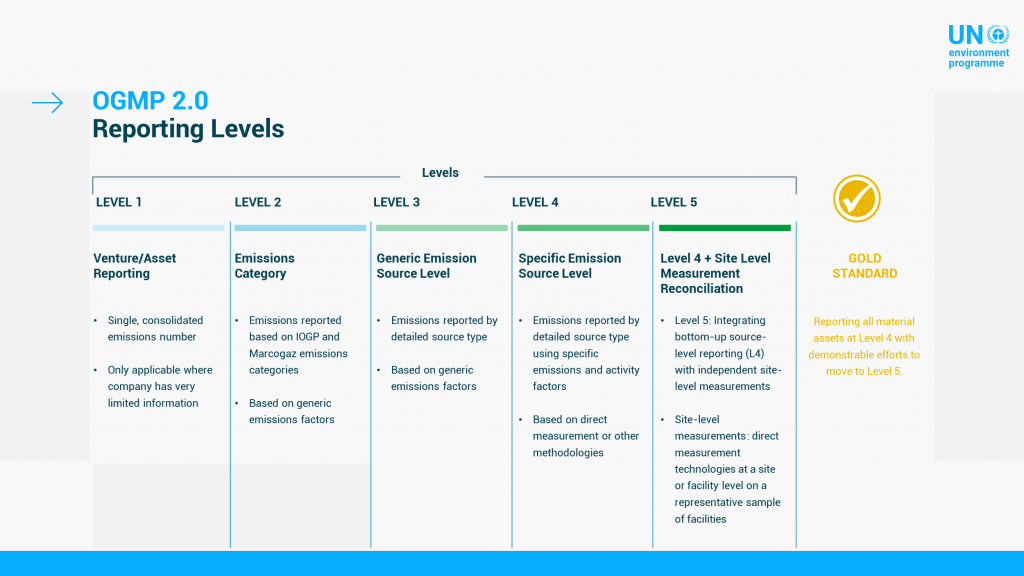
- Reporting Levels 1 & 2: High-level and aggregate estimates of emissions using generic emission factors.
- Reporting Level 3: Source-category level reporting (e.g., combustion, venting, flaring, fugitive components).
- Reporting Level 4: Detailed, source-level measurements for operated assets rather than relying purely on factors.
- Reporting Level 5 (Gold Standard Requirement): Reconciling source-level (Level 4) emission inventories with independent site-level measurements across all material assets (covering at least 95% of a company’s total emissions) within prescribed timelines.
Technology used for source measurements are varied, and OGMP leaves this to companies and countries to specify. However self-reported data is cross-checked with satellite data from the US National Oceanic and Atmospheric Administration (NOAA), and UNEP’s Methane Alert and Response System (MARS) at the International Methane Emissions Observatory.
The World Bank’s Global Flaring and Methane Reduction (GFMR) Partnership references the OGMP 2.0 as an entry requirement for countries seeking grant and technical support to achieve methane emissions reduction and end routine gas flaring in oil and gas projects by 2030.
Four days ago, QatarEnergy announced achieving the OGMP 2.0 Gold Standard for the 2025 reporting year, which is a significant milestone for one of the world’s largest LNG producers.
There is still more work to be done, as the GFMR reports consecutive increasing flared gas over the last three years, resulting in 167 bcm reported in 2025 – the highest flare gas volume since 2019. From its report for comparison, this is equal to Africa’s annual consumption and its value of $54 billion is half the upfront investment needed to eliminate routine flaring. This is a wasted opportunity but also a reminder of the scale of work to be done in our collective march to next zero and limiting anthropogenic temperature increase to the Paris Accord’s goal of 1.5°C above pre-industrial levels.


Leave a Reply