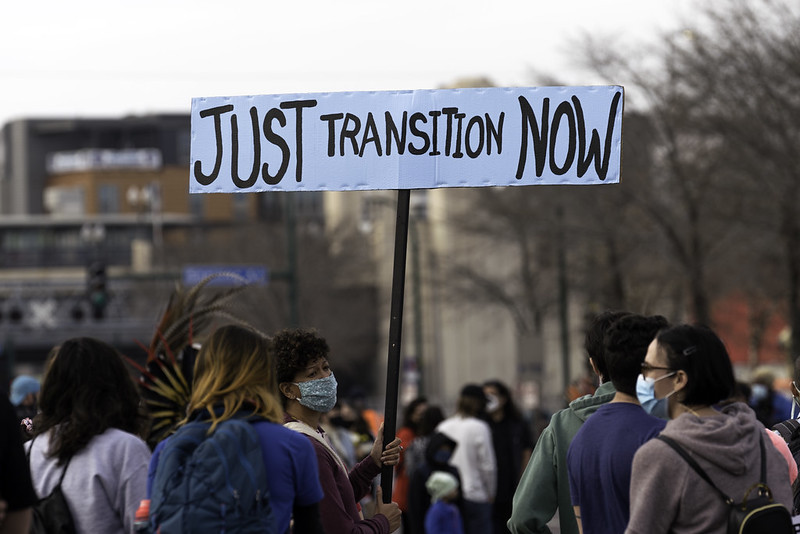
Photo credit: Lorie Shaull, shared under a Creative Commons License.
Healy and Barry (2017:451) posit that the transformation from carbon-intense to low-carbon energy has historically focused disproportionately on energy technology. Their work responds to two issues that need more highlighting in energy justice literature: firstly, a just transition that considers life cycle analysis and secondly, the role of the divestment movement in the sociopolitics of the energy transition.
Advocating a just transition, they recommend life cycle analysis with greater emphasis on the labour and carbon communities’ argument. A transition away from carbon systems risks social injustice unless carbon system workers and communities are transitioned into new energy jobs of the green economy. The politics of this labour and economic risk is why carbon communities, unions and actors resist a rapid transition to decarbonization. A greater understanding of the power dynamics of the sociopolitical energy transition can be achieved through a holistic analysis of carbon system effects. Another point made is that carbon actors have been happy for climate conversations to focus only on end-use effects and that this lopsidedness has birthed the divestment movement, which seeks to “shift energy justice policy attention to the upstream supply side” (2017:453).
The divestment movement, formed as a result of what Ayling and Guggingham (2017:131) call a “failure of inter-governmental initiatives to deliver credible climate change mitigation” has brought radical tactics focused on reputational damage, delegitimization or contemporary cancel culture, to guilt institutions into defunding carbon investments. They seek to prevent carbon lock-in, protect investors from stranded assets, and reverse the ecological damage of extraction. They stress “the urgent need to halt fossil fuel exploration, extraction and production, end fossil fuel subsidies, and also publicly acknowledge and tackle fossil fuel industry-funded climate denial” (Healy and Barry, 2017:454). Extinction Rebellion is a prominent divestment group that has succeeded in turning institutional attention to the ongoing human-caused sixth mass extinction event.
It is glaring however that the paper focuses on “decarbonization energy transition” justice, “from extraction to final use” (2017: 451) and fails to investigate justice in the sense of existing anthropogenic carbon and the current unjust, inordinate ramifications on the populations of especially the global south. Greenhouse gas effects are cumulative (Calculating the Cumulative, 2014) and Skoufias (2012:6) expounds that “climate change impacts tend to be regressive, falling more heavily on the poor than the rich”. If we only proceed with justice in transition systems, who deals with the injustice we created in the past?
BIBLIOGRAPHY:
MAIN ARTICLE REVIEWED
- Healy, Noel, and John Barry. “Politicizing energy justice and energy system transitions: Fossil fuel divestment and a “just transition”.” Energy Policy 108 (2017): 451-459
OTHER REFERENCES
- Calculating the Cumulative Cost of Carbon Dioxide Emissions, 2014, Taylor and Francis publishing, [online] Available at: <https://phys.org/news/2014-07-cumulative-carbon-dioxide-emissions.html> [Accessed 4 November 2020].
- Julie Ayling & Neil Gunningham (2017). Non-state governance and climate policy: the fossil fuel divestment movement, Climate Policy, 17:2, 131-149
- Skoufias, E., ed. (2012). The Poverty and Welfare Impacts of Climate Change: Quantifying the Effects, Identifying the Adaptation Strategies. Washington, D.C.:.World Bank.


Leave a Reply